
How a PT Clinic Builds the Authority (Backlinks) to Rank
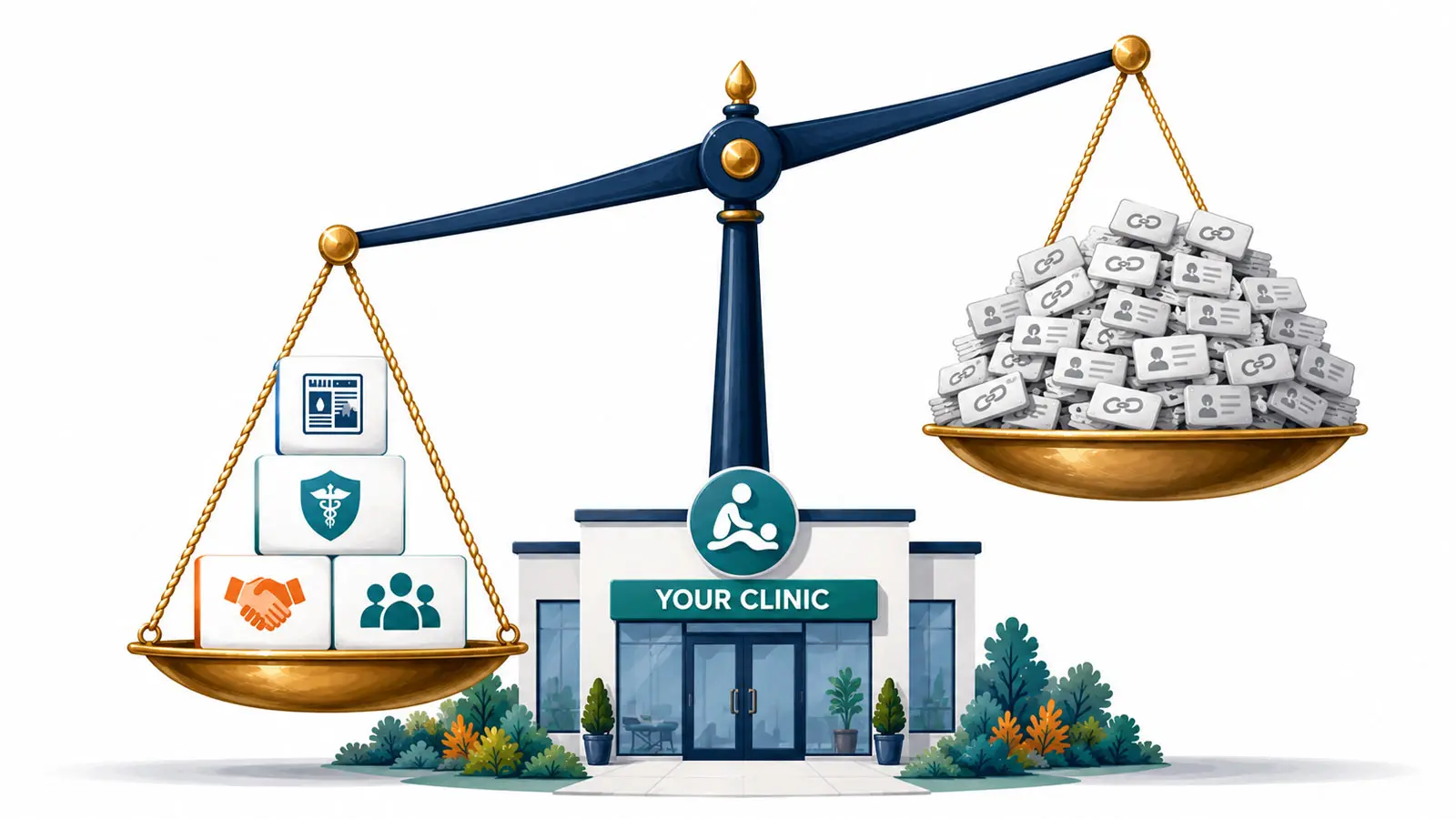
A physical therapy clinic builds ranking authority by earning a small number of high-quality, relevant backlinks — links from credible sites like local news, health directories, professional bodies, and community partners. In 2026 it’s about quality, not volume: a few trusted, genuinely earned links do more than hundreds of low-value ones, and buying links or using schemes now works against you.
Here’s the part that should make this less intimidating than it sounds. If you’ve run a clinic for any length of time, you’ve already earned most of the links you need — you just haven’t claimed them online. The gym that sends you referrals, the running club you patch up, the charity 10k you staff the physio tent for, the suppliers and GPs you work with: those are real relationships, and a real relationship is exactly what a backlink is meant to represent. Most “link building” for a clinic isn’t building anything new. It’s digitizing what you already have.
The rest of this guide covers what backlinks actually are, which ones move the needle for a clinic, how to earn them without paying a penny — starting with the ones already sitting in your contacts — and how to steer clear of the kind that get you penalized.
What are backlinks, and why do they matter for a clinic?
A backlink is simply a link from another website to yours. Google treats each one as a vote of confidence — a signal that a real site thought your content, or your clinic, was worth pointing its own readers toward.
Backlinks remain one of Google’s strongest ranking signals, and they’re the “Authoritativeness” leg of E-E-A-T — the off-page counterpart to the on-page trust signals we cover in proving the authority Google trusts. One is the credibility you build on your own pages; the other is other sites vouching for you. And because a genuine link stands for a real-world relationship, it’s one of the hardest signals to fake — which is precisely why Google still leans on it.
Google has softened how it talks about links publicly, but they still count — and they increasingly feed AI search too. Being cited by trusted sites now helps you surface in AI Overviews and tools like ChatGPT, not just the classic blue links.
What kind of links actually help a physical therapy clinic?
Relevance, locality, and trust beat raw numbers every time. One link from a source that genuinely relates to your clinic and its area is worth more than dozens of generic, unrelated ones.
For a PT clinic, the links that carry real weight come from exactly the places you’re already connected to: local news and community sites, reputable health and medical directories, professional associations, and the local organizations you actually work with — gyms, sports clubs, running groups, GPs, and suppliers. Notice that these aren’t strangers you have to cold-pitch; most are people who already know you. Many of them also overlap with the local citations that power your map-pack visibility, which we cover in why local SEO matters for a clinic.
The test is straightforward, and it’s the same one Google applies: would this site be a sensible place for a prospective patient to find you? If yes, the link helps. If it’s a random directory no human would ever read, it doesn’t.
How does a clinic earn backlinks without buying them?
You don’t need to pay for links — and you shouldn’t. The reliable way to build a clinic’s authority is to give real local sites a genuine reason to link to you, a few strong links at a time. And the fastest way to start is to stop thinking about “building” and start with an audit of what you already have.
Sit down and list every real relationship your clinic has: the teams and events you sponsor (sponsor pages almost always link back), the gyms, clubs, and clinics you partner with, the suppliers you buy from, the charities you support, the local journalists who’ve quoted you or might. Then, one at a time, ask each of them for the thing they’d happily give anyway — a link on their partners page, a mention in their write-up, a listing on their site. That’s not a marketing campaign; it’s a handful of emails to people who already know your name. Most clinics have a dozen of these sitting unclaimed.
The other durable source is content worth linking to. Practical, genuinely useful pieces — clear injury and recovery guidance, real answers to the questions patients actually ask — are what local sites and other professionals cite. If your content isn’t useful enough that someone would share it, no amount of outreach fixes that. (For the fundamentals of content that ranks, start with our SEO 101 guide.)
A note on AI: tools like ChatGPT can help you draft and outline faster, and there’s nothing wrong with that. What they can’t do is replicate your first-hand clinical experience — the real cases, the patterns you see, the judgment built over years of treating patients. That experience is what makes content link-worthy in the first place, and it’s the one thing a competitor or an AI can’t copy. Use AI to speed up the work; keep your own clinical voice at the center of it.
Can bad backlinks hurt my clinic?
Yes. Bought links, link schemes, private blog networks, and mass low-quality directory listings can actively work against you. At best Google ignores them; at worst they cost you rankings you already had.
Google’s link spam policies are enforced continuously in the background, so manipulative links get devalued whether or not there’s a visible “update.” Here’s the clean rule that keeps you on the right side of it, and it’s the flip side of everything above: would this link exist if search engines didn’t? A link from the club you sponsor would exist anyway — it stands for something real. A link you bought from a directory no patient will ever read exists only to game rankings. Build the first kind, never the second, and penalties stop being something you have to think about.
In short
Building a clinic’s authority isn’t about chasing hundreds of links — it’s about claiming the few genuinely relevant, trusted ones you’ve usually already earned, and never paying for the rest. It compounds slowly and it’s hard to fake, which is exactly why it works — and why a clinic that’s genuinely woven into its community has an edge no competitor can simply buy.
If you’d like a hand building your clinic’s authority the right way, see how we approach SEO for physical therapy clinics.
FAQ
How many backlinks does a PT clinic need? Fewer than most owners expect. A handful of relevant, trusted links beats hundreds of low-quality ones — and most clinics already have a dozen worth claiming from the partners, sponsors, and local organizations they work with.
Do I need to pay for backlinks? No — and you shouldn’t. Paid links and link schemes are net-negative in 2026. Earn them instead through useful content, local partnerships, sponsorships, and being a genuine local source.
Do backlinks help with AI search? Yes. Links from trusted sites feed visibility in AI Overviews and generative tools like ChatGPT, not just classic Google rankings.


